
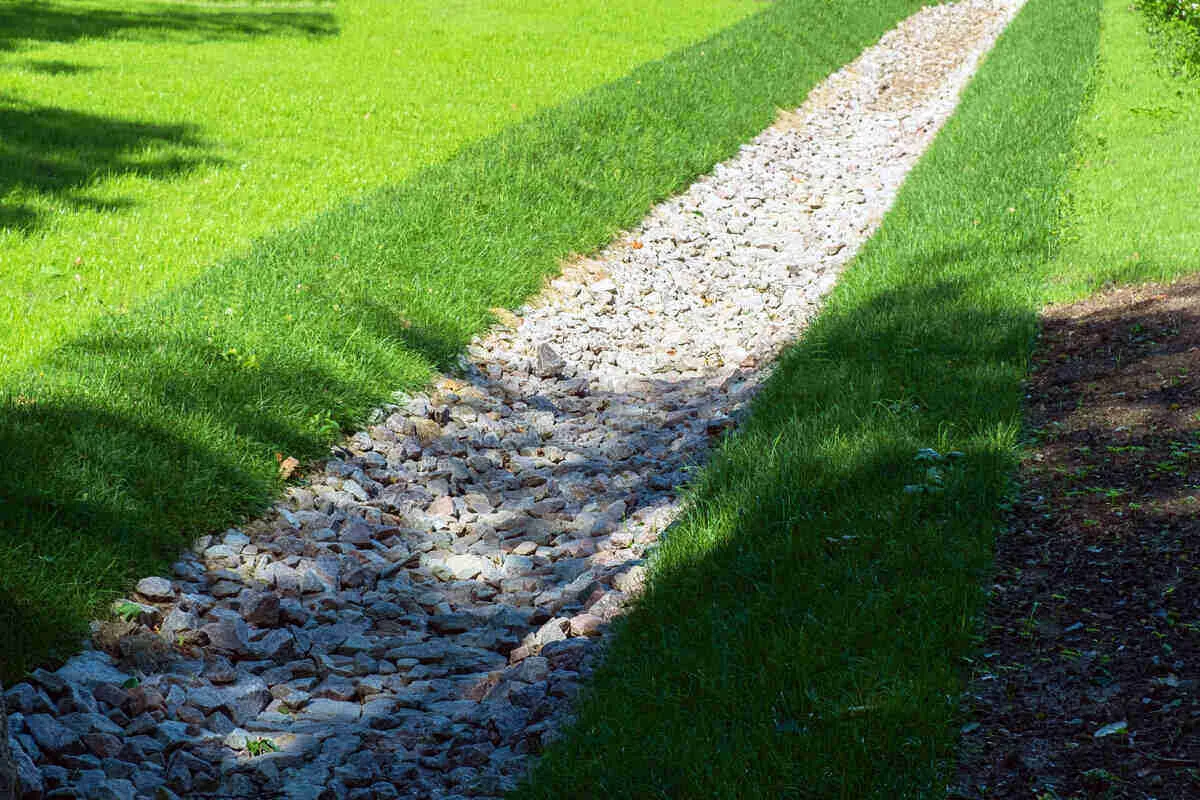
How much does a French drain cost in Louisiana?
A French drain in a Louisiana yard runs about $10 to $75 per linear foot installed (Lawn Love), so 100 feet lands near $1,000 to $7,500. Bob Vila puts a standard exterior run at $10 to $50 per foot. Fixr calls the national average project $5,000.
Those are published national ranges from cost guides, not a quote for your yard. Wet clay and the run to the nearest ditch move the number down here. Here is how the pricing works and what changes it.
What does a French drain cost per linear foot?
Most yard drains are priced by the foot. Bob Vila puts a standard exterior French drain at $10 to $50 per linear foot and a deeper yard trench at $30 to $90. Fixr lists exterior work at $10 to $100 per foot, with a $25 average. Interior basement drains cost the most.
| Drain type | Published cost per linear foot | Publisher |
|---|---|---|
| Curtain drain | $10 to $25 | Bob Vila |
| Standard exterior drain | $10 to $50 | Bob Vila |
| Exterior drain, full range | $10 to $75 | Lawn Love |
| Deep yard trench | $30 to $90 | Bob Vila |
| Footing drain at a foundation | $80 to $100 | Fixr |
| Interior basement drain | $40 to $100 | Fixr and Lawn Love |
Most houses around here sit on a slab with no basement, so the interior rows rarely apply. The exterior rows are the ones that match french drain installation around New Iberia. The job is a trench, a pipe, washed gravel and a place for the water to leave.
Labor is most of the bill. Bob Vila puts installation labor at $50 to $100 per hour. The parts are cheap next to the digging. Fixr prices 4 inch perforated pipe at $1.00 to $1.50 per foot.
What does a 50, 100 or 200 foot French drain cost?
Length sets the total. LawnStarter prices an exterior French drain at $500 to $3,250 for 50 feet, $1,000 to $6,500 for 100 feet and $2,000 to $13,000 for 200 feet. Fixr runs tighter at those lengths. Lawn Love reaches higher on long runs.
| Length | LawnStarter, exterior | Lawn Love, exterior | Fixr, exterior |
|---|---|---|---|
| 50 linear feet | $500 to $3,250 | not listed | $1,250 to $2,000 |
| 100 linear feet | $1,000 to $6,500 | $1,000 to $7,500 | $3,500 to $4,000 |
| 200 linear feet | $2,000 to $13,000 | $2,000 to $15,000 | not listed |
| 300 linear feet | not listed | $3,000 to $22,500 | not listed |
Fixr, LawnStarter and Lawn Love all call the national average project $5,000. The spread is wide because the same two words cover two different jobs. A shallow gravel trench in dry ground and a 24 inch deep drain in wet clay both get sold as a French drain. Acadiana sits at the wet end, so yard drainage dug with a mini excavator tends to price above the bottom of these ranges.
What moves the price of a French drain in Acadiana?
Four things move it here: trench depth, the run to a ditch, hauling clay off, and putting the yard back. Acadiana soil pushes on all four at once. A drain that would be routine on sandy ground gets slower and wetter down here.
The clay. The USDA soil survey names the Iberia series after this parish, with its type location about five miles east of New Iberia. It is a very fine clay, poorly drained, with very slow permeability and slopes under half a percent. A perched wet layer sits within two feet of the surface from December through April. Water has nowhere to soak.
The fall. Water moves on slope. On ground this flat, fall has to be cut into the trench across its whole length. Reaching the roadside ditch or the coulee often takes a longer run than the wet spot suggests, and every extra foot gets priced.
The spoil. Pipe and gravel take up room in the trench, so the clay that came out does not all go back in. It gets loaded and hauled. That is machine time and trailer time on top of the trenching.
The finish work. LawnStarter lists a dry well at $500 to $3,000 and a storm drain at $500 to $3,500. Bob Vila puts a catch basin at $20 to $130. Lawn Love prices sod at $0.90 to $1.80 per square foot and grass seed at $0.10 to $0.19 per square foot to close the scar.
When is a French drain the wrong fix?
Sometimes a yard needs grading instead of a pipe. If water sheets off a high spot and sits in a low one, regrading moves it for less money. If the ditch along the road is silted shut, cleaning the ditch drains the yard. If water backs up at the driveway, the culvert is the problem.
A grading-only fix belongs with yard leveling and lot grading. Cut the low spot so it drains, shape a shallow swale, and the water leaves on its own with no gravel to maintain later.
A blocked driveway crossing is its own job. Read driveway culvert installation and what a driveway culvert costs in Acadiana first. Check the pipe sizes and the parish rules before you price a drain you may not need.
A silted ditch is often the cheapest fix on the list. The parish keeps the road ditch. The ditch inside the property line is yours, and once it fills in it backs water into the yard. Reshaping it with an excavator is part of ditch digging and ditch cleaning.
Do you need a permit, and where can the water go?
Call 811 before anyone digs. Louisiana law requires 48 hours notice to the state notification center, not counting weekends and holidays. The wait starts at 7 a.m. on the next working day (Louisiana 811). Marks stay good while they are visible, up to 20 calendar days. Permits are a separate question and vary by parish.
Where the water may go is set by state law. Louisiana Civil Code article 655 covers natural drainage. A lower estate is bound to receive surface water that flows naturally from the estate above. That holds unless an act of man created the flow. Article 656 says the lower estate may not block that flow, and the upper estate may not make the burden worse (Louisiana State Legislature).
Piping standing water into a neighbor’s yard is an act of man. That is why a drain here should end at a ditch, a coulee, a pond or a low area on the same property. LSU AgCenter says the same thing: send water to ponds, ditches, culverts or low-lying areas, and check local rules on smaller lots.
Those local rules differ by government, and some limit a single point of discharge onto a road or a neighboring lot. Lafayette Consolidated Government runs a drainage department for parish ditches and coulees, reachable at 311 or (337) 291-8200. Call your parish or city permit office before tying a line into a public ditch.
How do you get a real number for your yard?
A real number comes from looking at the yard. We find the low spot, check the fall to the nearest ditch and measure the run. Depth, run length, the spoil to haul and the place the water leaves are what turn a national range into a price for one lot.
Estimates are free and done on site, in New Iberia, Lafayette, Abbeville, Broussard and the rest of Acadiana. Call (337) 201-0594 or ask for a drainage estimate.